I decided that it was time to get this blog out of
mothballs, blow off the dust and bring it up to date. The fact is that regarding my aquaponics
project, which I first started planning seven or eight years ago, that
inevitable obstacle of funding delayed any practical moves towards
realization. Hence the sale of my house.
First the refurbishment.
Then the ‘For Sale’ sign.
Then, after a considerable wait, the sale – which rather
inconveniently occurred during a long planned visit to Tasmania and New Zealand
to visit friends and family. My visit
took place between November 2013 and January 2014, with the house sale being
completed in January. Thus, much needed funds were liberated!
Keeping it brief, I was able to come to an agreement with
second son, which helped him to buy a large enough property to provide space
for me to live, and develop the aquaponics – although the funds necessary to
get started were still not immediately available. There is, however, a large garden, a section
of which became mine to deal with – completely overgrown with bramble, nettle, buddleia
and convolvulus. We all took over the
property in September 2014.

Next steps:
We refurbished the old static caravan for my accommodation. New floor, some walls, rebuilt inside to my
specification,

and cut back top growth in garden plot (about 35m x 15m).
I couldn’t yet afford the planned insulated greenhouse for
the aquaponic system, so work began to get stuff growing in the garden. We cut
down some trees, and shifted some earth about with a digger.


I laid out some beds, using our cardboard
removal boxes for weed suppression. Imported about three tonnes of compost from
local authority recycled garden waste.
Put up a small greenhouse I brought from the last place.
I refurbished an old cedar greenhouse which had been left
derelict for 10 or 15 years – stripping the ivy from inside and out, having new
roof vents made, replacing glass which the ivy had broken, and digging out a
sycamore tree which had self seeded in front of the door. Total cost for an
excellent 8ft x 12ft cedar greenhouse, £600!

I started serious food growing in a small way in 2015, while
continuing to break in what was effectively virgin ground (although it had once
been a fine productive garden). It soon
became clear that rabbits would be a problem, so rabbit fencing had to be
installed round all beds. Rats became very interested in my compost bins!

By spring 2016, I had a proper garden, although brambles,
docks and nettles continued to be a nuisance.
Constant strimming of the areas between the beds allowed grass to take
over from docks, nettles and brambles.
I was at last able to release enough money to purchase an 8m
x 6m insulated Keder greenhouse. Before its arrival, I had built a sunken sump
tank with concrete blocks, setting them on a concrete base about 1m below
ground level.

Then with ongoing help from second son and a hired digger, we
prepared the site for the arrival of the installation team. The greenhouse was installed in a couple of
days, at a cost approaching £7000. (You can see why I had to sell my
house!)

The greenhouse arrived partly on a pallet, and partly on the roof of the fitters' truck.

It was difficult to envisage a 8m x 6m greenhouse emerging from this lot!

Meanwhile I needed to stay on top of the gardening outside
and in the two small greenhouses, and as winter approached and the weather worsened
(the site proving pretty windy) I found my desire to continue with outside
activities somewhat diminished!
Entering summer 2017, my garden is in reasonable shape. I am forced to admit that I am no longer able
physically to achieve what I might have done even 10 years ago.
However, the sump tank is insulated, lined
with board, and fibre-glassed (this by an expert).

The fish tank, which used to be the water
tank in the roof space of a demolished school, is in place, after some manhandling through the 2m wide entrance.

It is glass fibre
and insulated. It has been filled and tested for leaks, as has the sump
tank. The fish tank will hold in excess of 2000litres of water, and the sump tank more than 1000litres.

I have laid the first of two 3m x
1.2m concrete pads which will be the bases for the grow beds. I have purchased some IBCs which will be
cannibalized to make the grow beds. I
have also purchased six ready-made auto-syphons, for the flood and drain system
in the grow beds.
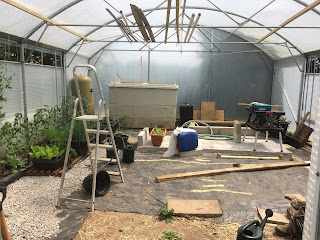
Meanwhile, so that the big greenhouse is starting to earn
its keep, I have made a raised bed down one side, where I am growing cherry
tomatoes, roccoto chillies, cape gooseberries and Lord Nelson sweet peas
(because I like them and they will attract pollinators!) I also have tubs with more tomatoes, carrots,
spring onions, lettuces, parsley and coriander, as well as three citrus fruit
trees. Next I must lay the second concrete pad, and build the block piers to
support the grow beds.
Soon I must have
second son install mains electricity, and to follow, a heating system for the
fish tank, using partially mains supply and partially a solar thermal
panel. The mains supply will eventually
be supported by solar PV panels which currently connect to the main house.
I have yet to buy the pump, the heart of the system, and the
air pump for the fish tank.
Just to be clear; if this was to be a commercial exercise I
would be building a different system which would be designed to produce a large
quantity of a few profitable plants – salad leaves and herbs. But I have
different goals. I want to provide a
wide variety of food for the family in as sustainable way as possible, and
also, perhaps, to demonstrate the possibilities for the system as a community
project, as climate change tightens its grip, with an inevitable impact on food
production and cost.
So far so good! I
hope to have the system running this year, but without fish while I cycle up
the system, developing the bacteria in the grow beds (which convert fish waste,
i.e. ammonia, into nitrates which the plants can use) and balancing the pH in
the water. I will be growing plants
during this phase and would hope to order fish next year: I will be growing
Tilapia, which is the reason for heating the fish tank. I am hoping that the fish tank and sump totalling
about 3000 litres of warm water (about 25 degrees C) in the insulated greenhouse will help me to a longer
growing season, particularly if in winter I supplement the natural light with
some grow lights.
That’s it – up to date for the moment. More to follow as and
when.
